Buying a House With Big Trees? What the Home Inspection Won't Tell You.

Updated: Sep 26

You're 2 weeks from closing on a house you already love, and part of why you love it is the trees. The inspection report came back. 40-some pages of it. The trees got a line and a half, and that line was about the limbs touching the roof. You read it and moved on, because you assumed somebody had looked at them. They were, but…
The question answered during the home inspection is narrower than you might think.
Alabama's home inspection standard covers the trees on that property only when they're likely to damage the house. Whether a tree is likely to hurt you, your car, your children, or the neighbor's roof is a different question, and the standard doesn't ask it. And even where a tree does threaten the house, your inspector isn't required to tell you whether it's going to fail.
What the Alabama standard actually says.
Home inspectors in this state work to a standard written into state regulation. It's Ala. Admin. Code r. 355-18-1-.01, adopted from the American Society of Home Inspectors' standards of practice. Trees are in that standard. Section (4)(a)1.(v) tells the inspector to inspect "the vegetation, grading, surface drainage, and retaining walls on the property when any of these are likely to adversely affect the building."
The rule only applies when the house is at risk.
A mature water oak with a decayed root collar, leaning over the driveway where you'll park every night, sits outside that sentence. So does the willow oak reaching across the property line, which is a conversation you'd much rather have before you sign than after.
Here is the problem.
Same rule, section (13)(b)2.(vi). Inspectors are not required to determine "future conditions including, but not limited to, failure of systems and components."
That's the entire question with a tree.
A tree standing quietly on a still Tuesday in August tells you almost nothing about that same tree in a storm. Whether it stays up is a prediction, and the standard your inspector works to puts that prediction outside his assignment. Your inspector didn't skip your trees. He inspected them against a standard that asks a different question than the one you need answered.
The rule is honest about this. It calls itself "a minimum and uniform standard for inspectors," which is a starting point. Additionally, InterNACHI, which certifies home inspectors, teaches that trees belong to a certified arborist.
What this looks like when it goes wrong.
I was contacted by a client who just purchased a home in Hoover, Alabama. He wasn't even completely unpacked. He called me because he noticed something on one of the trees and was concerned. I came out, inspected the tree, and regrettably had to tell him it needs to be removed. The tree has a high risk of failure and could substantially damage his home, the neighbor's home, or someone inside either home.
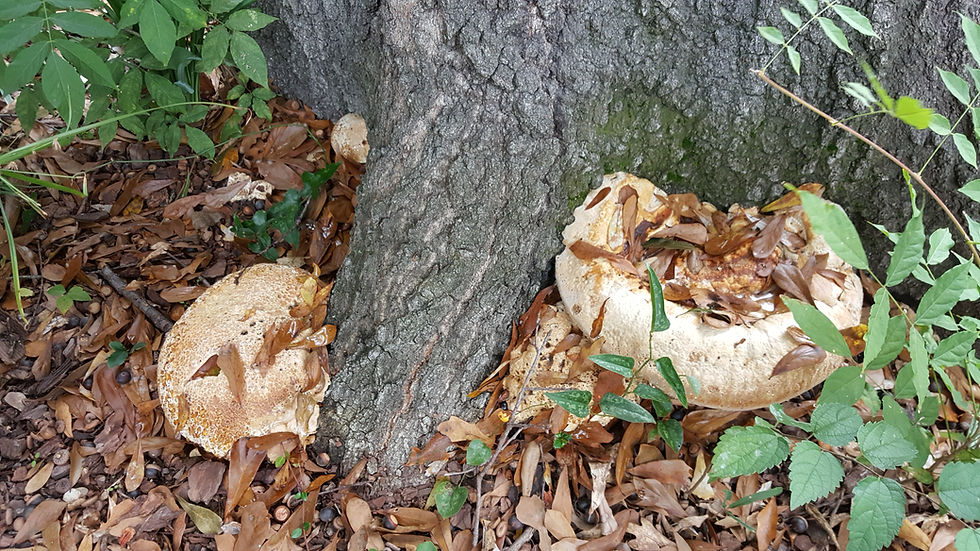
The tree had extensive decay around the base, insect borer damage, fungal rot, and canopy dieback. This homeowner has now inherited a high-risk tree. He's now out an additional $2,500 to $3,500 and hasn't even completely unpacked. This isn't the first time I've seen this. I've had a client in Homewood, Alabama look me in the face, tears in their eyes, and tell me, "David, the only reason I bought this home was for this tree, and now you're telling me it has to be removed."
I say all this because this should have been discovered before closing, and if it isn't, you inherit every tree in its current condition, whether healthy, sick, diseased, or unsafe, on the day you close. A dead, dying, or defective tree can be a liability and an unexpected expense.
Why this hits harder in Jefferson County and surrounding areas.

Most of what holds a big tree upright is underground and out of sight. Trees in our area tend to be shallow-rooted. The roots grow way further out from the tree than they do down. We have compacted soils composed mostly of clay and rock that limit ideal soil conditions for roots to grow and anchor.
Root ball anchorage matters. Ask yourself: what holds the tree upright? It's the root system. That root ball, if rooting is limited, combined with wet, saturated soils and strong thunderstorms, is a potential concern, even for what we would consider a healthy tree. Now combine all those symptoms with a tree that has a root rot disease.
None of that likely shows up in a home inspection walk-around.
So that raises the question: Who is capable of seeing this? Who knows what to look for? The answer to that is someone who is a trained, competent professional who knows trees and doesn't just cut them down. Let's be honest, if the tree is dead, you really don't need anyone to tell you that. You just need it removed. Call three tree removal services. Get three quotes. Remove it.
The critical window, and what happens when it closes.
The inspection contingency is a window that closes. While it's open, a written assessment of the trees is a document you can present to a seller. After it closes, the trees are yours, and so is everything they do. That's worth looking at on a calendar. The inspection period lasts a set number of days from the date of the binding agreement, and it runs whether or not anyone looks at the trees.
The tree doesn't change. What changes is who owns the trees when this window closes. If you want the trees inspected, do it in the same window as the home inspection, not after you have the keys.

If you're under contract on a house in Birmingham, Homewood, Hoover, Mountain Brook, Vestavia Hills, or surrounding areas and there are big trees on it, call me at 205-854-3676 while the window is still open. I don't remove trees. No crew, no chipper, and nothing riding on the recommendation I hand you. As I put it on my own website, you wouldn't call a mortician to save someone's life.
If you want to know what I'm looking at once I get to the base of a tree, I wrote that up separately: Is My Tree Going to Fail? 4 Important Signs That I Look for That You Don't. And if the next question is what this costs, that one has its own answer in What Does a Tree Assessment Cost? The rest of it needs me standing at the tree.
Common questions
Does a home inspection cover the trees on the property?
Partly. Alabama's Standards of Practice for Home Inspectors require the inspector to look at vegetation on the property when it's likely to adversely affect the building. A tree that threatens the driveway or the neighbor's roof falls outside that requirement.
Can a home inspector tell me whether a tree is going to fall?
He isn't required to. The same Alabama standard states that inspectors are not required to determine future conditions, including the failure of systems and components. Whether a tree will remain standing is a prediction, and that prediction falls outside a home inspection.
What is a pre-purchase tree inspection?
A tree risk assessment performed while you're under contract, before the inspection contingency closes. A consulting arborist examines the trees and puts the findings in writing, so you can act while you still have the option.
When should I have the trees inspected when buying a house?
In the same window as the home inspection. Once the contingency period closes, the trees are yours along with everything they do.
Who inspects trees when you're buying a house in Birmingham?
A Board Certified Master Arborist or ASCA Registered Consulting Arborist. Ask whether they also sell removal work, because an arborist who consults and is not affiliated with a tree removal service has nothing riding on the recommendation.
A word of warning about what you're reading online.
The internet is now flooded with tree care articles that were never written by anyone who has actually stood under a tree. They are generated by AI, assembled from scraps of other articles that were themselves assembled from scraps. The information sounds authoritative. It is polished, confident, and generic, and it has never inspected a single tree. I call it white noise.
Here is the problem: your tree is not generic. A warning sign that means very little on a healthy young oak in sandy soil can mean everything on a mature tree sitting in our Birmingham clay and rock. No article knows which one you have.
Everything I write here comes from over 10,000 trees inspected with my own eyes and hands, and even then, I will not diagnose your tree from a webpage, a photo, or a phone call. Neither can an AI that has inspected exactly zero trees.
Use what you read online, including my own articles, as education, not as a diagnosis. When it comes time for a real answer about a real tree, there is no substitute for a trained, credentialed professional standing in your yard.
David W. Boggan is an ISA Board Certified Master Arborist, ISA Certified Arborist Utility Specialist, and ISA Tree Risk Assessment Qualified, and a consulting arborist serving Mountain Brook, Vestavia Hills, Homewood, Hoover, and the greater Birmingham area. He helps trees and does not cut them down. Learn more at alabama-arborist.com.


Comments