What Does a Tree Assessment Cost?

Updated: Sep 26

Someone is coming out to look at your tree today, "for free." Seems to be a great deal. Who doesn't like something for free? Most free offers have a price. Maybe you just haven't realized it yet.
A free look and a paid tree assessment are two different products built for two different purposes. Most homeowners never learn which one they received. Yes, free gets most of the attention and calls because there is little or no perceived financial risk.
Value earns trust.
Trust is developed when someone experiences genuine expertise and receives meaningful value. Some examples of this are:
• Correctly diagnosing why a tree is declining
• Explaining risk in a way the owner understands
• Saving a tree instead of unnecessarily removing it
• Helping a client avoid spending thousands of dollars on the wrong tree treatment
• Providing an unbiased opinion because I'm not trying to sell tree work
A tree owner may call a tree service because they offer a free estimate, but that estimate usually is intended to sell removal or pruning. Most of the money in this industry is in removal and then pruning.
Search Google for an arborist in this area and look carefully at what comes back. The paid ads and the business listings on the map are almost all categorized under Tree service rather than Arborist. A business chooses that category itself, and it tells you what they actually sell. Try to find one listed under Arborist. You will find very few.
My business is different. I sell expert judgment. A homeowner wants confidence that the recommendation is correct.
Value is the confidence that you're making the right decision for your tree, your property, and your family.
So let's talk about money plainly. Here's what I charge, and what you get for it.
Why the free inspection costs the most
A free estimate works fine when you've already decided to take a tree down, and you need a price. It breaks the moment your question changes. If you're asking whether the tree needs to come down at all, you've handed that decision to the one person in the conversation who gets paid when the answer is yes.
I'll be blunt. Being able to fell a tree doesn't qualify someone to diagnose one. Those are separate skills, and only one of them requires knowing what's happening inside the trunk.
When you pay me for a consultation, you're buying an answer with nothing riding on it. I help trees. I don't cut them down. Clients take comfort in this fact.
The 3 levels, and where you actually start
Tree risk assessment follows a defined standard, ANSI A300 Part 9. It comes in 3 levels. Most articles list all 3 and leave you no wiser about which to ask for, so here's the practical version.
Level 1 is a limited visual assessment. It's a visual assessment from a specified perspective of an individual tree or trees, usually near specified targets such as homes, driveways, and structures. Level 1 focuses on identifying trees with an imminent or probable likelihood of failure.
A Level 1 is included in every tree consultation I perform. I'm looking for obvious defects such as:
• dead, dying, or defective trees
• large cavity openings
• large dead or broken branches
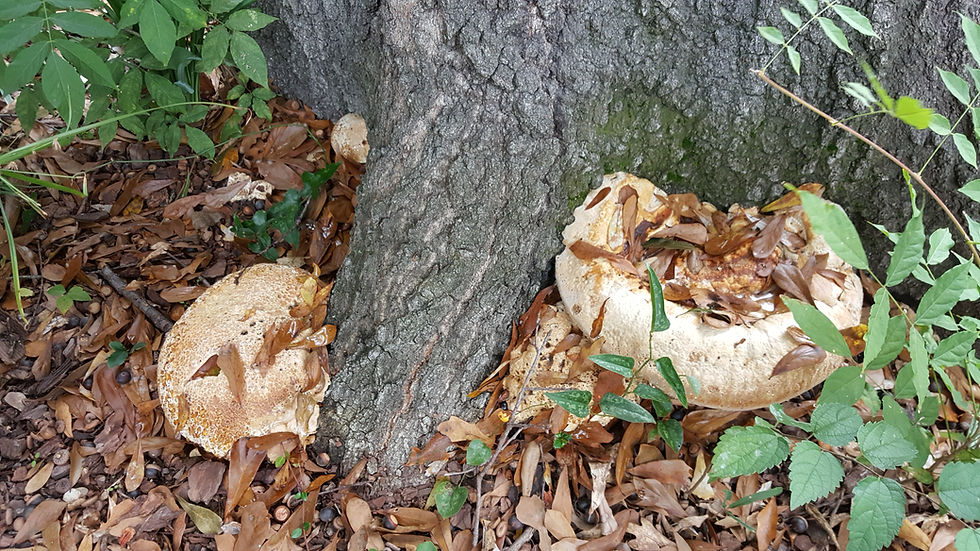
• fungal fruiting structures
• severe cracks or leans

Level 1 also works well on a larger property with many trees. Large property managers and golf courses use it to triage hundreds of trees and prioritize the ones carrying higher risk.
Level 2 is the basic tree risk assessment, and it's what a homeowner needs when a Level 1 can't resolve the tree question or concern. It's a 360-degree inspection. I walk around the entire tree and look at the root collar and trunk flare, the visible roots, the trunk, branch unions, structural defects, and the canopy.
I also assess site conditions where the tree grows, which matters more here than most people expect. What the soil is doing, and what's been built or dug nearby. What the tree would hit if it failed.
Level 3 is the advanced assessment. Measuring tools come out, or a climbing inspection, or a deeper look at the root system. You go to Level 3 when Level 2 finds something it can't resolve by eye, or when the stakes are high enough that a judgment call won't do. It costs more because it takes more.
Notice the order. Level 3 answers a question that Level 2 raised. Anyone selling you advanced diagnostics on a tree they haven't walked around or performed a Level 2 on is selling equipment time.
What $375 buys
My consultation is $375 in the Birmingham area, and that covers up to 2 trees.
This is what happens for that money. I meet you at the tree. We walk it together.
You ask your questions, and I answer them on the spot, in plain language, with no removal sales pitch attached. I'll also educate you about your tree, its health, its structure, how it lives, and how trees stand up and fall down. Every tree is unique, even the ones growing next to one another, so the answers vary.
During the consultation, I perform a Level 1 limited visual tree risk assessment. I inspect for risk and for tree health. I assess site conditions, tree structure, defects, and insect and disease problems. Then I give you my recommendations.
If I find something a limited visual assessment can't resolve, I'll recommend a Level 2 on that tree. That's $250 added to what we've already agreed, and I'll tell you what I found and why it needs the closer look before I do any of it. Most consultations never get there. The Level 1 usually answers what people called me about.
If I had to put a number on how often I recommend removal, it's less than 10%. What I recommend instead is usually something smaller. Pruning the tree. A soil problem to correct. A defect we watch on a schedule instead of acting on today. Sometimes the tree is fine and whoever scared you by saying it needed to come out was wrong. If you want to see what I'm actually looking at when I make that call, I wrote about this in Is My Tree Going to Fail? 4 Important Signs That I Look for That You Don't.
And if your tree does need to be removed, I'll tell you that, and you can be confident it's the necessary step to take. Think of a doctor. He tells you what's wrong, then he prescribes a plan, whether that's medicine or surgery.
You might hear any of those recommendations from me, because none of them cost me anything to say.
A few practical notes. Each additional tree is $75, and the consultation caps at 4 trees total. A row of evergreens such as Leyland Cypress or Cryptomeria counts as 1 tree. More than 4 trees is a different service, and I'll quote it separately. The first 20 miles are included, and I'll quote the travel once you give me the address.
A written report is a separate service
The consultation is verbal, delivered at the tree. When you need something in writing, that's priced separately, and the price climbs with the depth of the work.
There are 3 forms it can take.
A tree overview letter is the short version, a letter report carrying the summary, observations, analysis, conclusions, and recommendations.
A basic forensic letter sits in the middle, for situations that need real investigation and analysis behind the conclusions. These are used for insurance claims, contractor damage to trees, and neighbor tree disputes.
A full forensic tree report is in booklet format. It's built for complex cases and for anything headed toward an insurance company or an attorney, which typically means litigation.
Each of these is quoted after the consultation, once I know what the situation requires.
Ask for the report you need before I arrive. It changes what I document while I'm standing there.
4 questions to ask before anyone shows up
Ask these on the phone. The answers tell you what kind of visit you're about to get.
Do you remove trees? If the answer is yes, it's a conflict of interest.
Are you Tree Risk Assessment Qualified, and can I verify it? Verify anyone claiming to be certified. Anyone can print "certified arborist" on a truck door. The ISA directory tells you whether it's true, and it takes less than a minute.
Which level of assessment are you performing? Confusion here is your answer.
What do I receive when you're done? A verbal opinion, a written summary, and a formal report are 3 different things at 3 different prices. Know which one you're getting before the visit.
The number that should worry you
People sometimes flinch at paying $375 to have a tree looked at. I understand that. It rarely appears in a household budget. Then run the other numbers. Removing a large tree in this area can run $3,000 or much more. A mature tree that dies from construction damage takes decades of value off your property and can't be replaced in your lifetime. A tree that fails onto a house is a different order of expense. A tree that fails onto a person is something you never stop thinking about. Against those numbers, $375 is small. It's also the only figure on that list you get to choose.
Value isn't measured by what you pay for an assessment. It's measured by the costly mistakes that a sound assessment helps you avoid.
If you have a tree you're unsure about, call me at 205-854-3676 or use the contact form, and let's get you a real answer.
A word of warning about what you're reading online.
The internet is now flooded with tree care articles that were never written by anyone who has actually stood under a tree. They are generated by AI, assembled from scraps of other articles that were themselves assembled from scraps. The information sounds authoritative. It is polished, confident, and generic, and it has never inspected a single tree. I call it white noise.
Here is the problem: your tree is not generic. A warning sign that means very little on a healthy young oak in sandy soil can mean everything on a mature tree sitting in our Birmingham clay and rock. No article knows which one you have.
Everything I write here comes from over 10,000 trees inspected with my own eyes and hands, and even then, I will not diagnose your tree from a webpage, a photo, or a phone call. Neither can an AI that has inspected exactly zero trees.
Use what you read online, including my own articles, as education, not as a diagnosis. When it comes time for a real answer about a real tree, there is no substitute for a trained, credentialed professional standing on your property.
David W. Boggan is an ISA Board Certified Master Arborist, ISA Certified Arborist Utility Specialist, and ISA Tree Risk Assessment Qualified, and a consulting arborist serving Mountain Brook, Vestavia Hills, Homewood, Hoover, and the greater Birmingham area. He helps trees and does not cut them down. Learn more at alabama-arborist.com.


Comments